Wazir-e-Azam Apna Ghar Program: Rs 10 Million Loan at 5% Markup for First-Time Buyers

Is Article Mein
- Latest Update: 5% Rate Now Worth More After the SBP Rise to 12% (November 2026)
- Quick Facts About the Apna Ghar Program
- What the Apna Ghar Program Is
- Loan Amount, Markup and Monthly Installments
- Who Can Apply: Eligibility Criteria
- Who Cannot Apply Under the Program
- Which Properties Can Be Financed
- Documents Required for the Application
- How to Apply for the Apna Ghar Program
- Apna Ghar vs Apni Chhat Apna Ghar: Do Not Mix Them
- Important Points Before You Apply
- FAQs
- Conclusion
For most families in Pakistan, owning a home feels further away every year. Property prices keep rising, and a normal bank home loan charges a markup that pushes the monthly installment beyond what a salary can carry. Many families pay rent for years, not because they cannot afford a home, but because they cannot afford the interest on one.
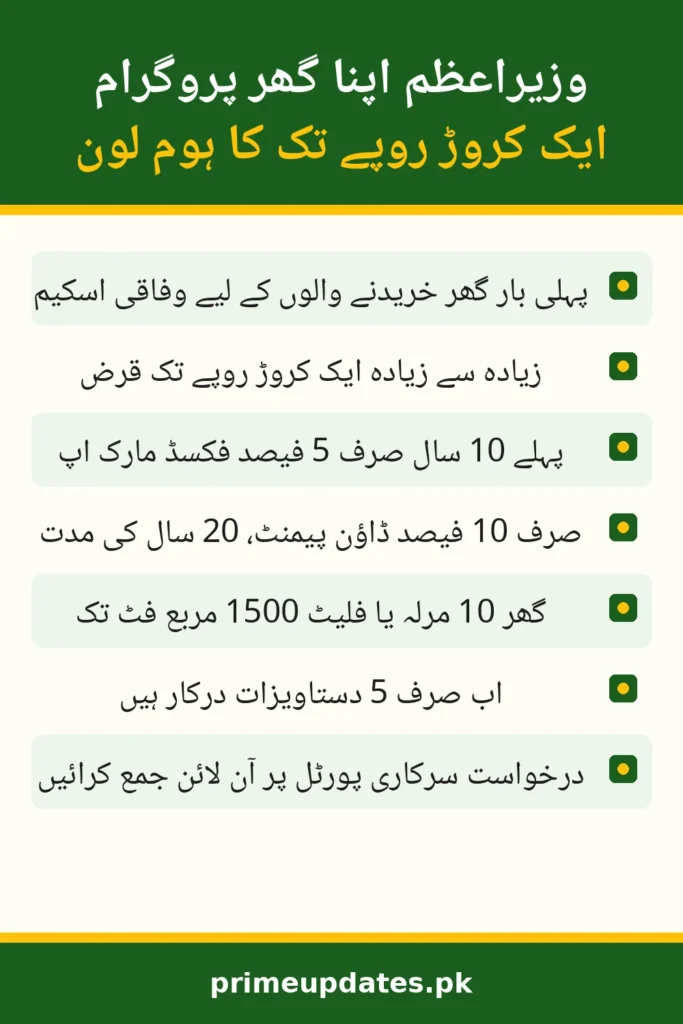
The Wazir-e-Azam Apna Ghar Program changes that calculation. This federal scheme offers first-time homebuyers financing of up to Rs 10 million at a fixed 5% markup for the first ten years, with only 10% of the property value needed as a down payment. This guide explains the complete official details in one place: who can apply, which properties qualify, what documents you need, and how to apply through the official portal or a participating bank.
Latest Update: 5% Rate Now Worth More After the SBP Rise to 12% (November 2026)
The 5% fixed rate became much more valuable in late October 2026. On 26 October 2026, the State Bank of Pakistan raised its policy rate by half a percentage point to 12%, effective 27 October, which pushed ordinary bank borrowing costs higher. The Apna Ghar Program’s fixed 5% customer rate for the first ten years did not change, so the gap between this scheme and a normal home loan is now wider than before.
Two more changes made the scheme easier in October 2026. On 14 October, the government cut the required property documents from 25 to just 5 and kept the 15-working-day limit for banks to decide on a complete application. By 23 October 2026, loans worth Rs 511 billion had been approved for 86,899 applicants, although only Rs 91 billion had actually been disbursed to 15,584 applicants, which is why the Prime Minister directed the State Bank and the Finance Ministry on 2 November to act against banks that delay disbursements.
Quick Facts About the Apna Ghar Program
The main details of the program are summarised in the table below. They are taken from the State Bank of Pakistan’s circulars, the official portal and the Ministry of Housing and Works.
| Point | Detail |
|---|---|
| Official name | Wazir-e-Azam Apna Ghar Program — Ghar Ho Tu Apna |
| Run by | Federal government through the State Bank of Pakistan |
| Who it is for | First-time homebuyers across Pakistan |
| Maximum financing | Up to Rs 10 million |
| Customer markup | 5% fixed for the first 10 years, then 1-year KIBOR + 3% |
| Maximum tenure | Up to 20 years |
| Your contribution | At least 10% of the property value |
| House size limit | Up to 10 Marla (2,720 sq. ft.) |
| Flat size limit | Up to 1,500 sq. ft. |
| Processing fee | No scheme processing cost |
| Early repayment | No prepayment penalty |
| Official portal | apnaghar.gov.pk |
| Helpline | 051-111-742-111 |
The program is a housing finance facility, not a free house or a cash grant. The government pays part of the markup for the first ten years and shares part of the risk with the banks, which is what makes the low fixed rate possible.
What the Apna Ghar Program Is
The program began on 24 September 2025 as the Mera Ghar–Mera Ashiana Markup Subsidy and Risk Sharing Scheme for Affordable Housing Finance, under State Bank Circular SH&SFD No. 3 of 2025. In its first form it had two tiers: loans up to Rs 2 million at 5% and loans from Rs 2 million to Rs 3.5 million at 8%. In March 2026 the scheme was expanded and simplified: the two tiers were replaced by one flat 5% rate for everyone, borrowers already paying 8% were moved to 5%, and the maximum loan was raised to Rs 10 million.
The scheme was renamed the Wazir-e-Azam Apna Ghar Program — Ghar Ho Tu Apna following a Ministry of Housing and Works notification of 26 March 2026 and a State Bank circular of 1 April 2026, and the Prime Minister formally launched the renamed program in Islamabad on 30 April 2026. Financing is delivered through more than 24 participating institutions, including commercial banks, Islamic banks, microfinance banks and the House Building Finance Company Limited, with Islamic banks offering the scheme through Diminishing Musharakah.
Loan Amount, Markup and Monthly Installments
The bank can finance up to 90% of an eligible property’s assessed value, while you contribute at least 10% as equity. The 5% fixed customer rate applies for the first ten years only. For any remaining tenure, the rate becomes the prevailing one-year KIBOR plus 3%, so your monthly payment will rise after year ten. With one-year KIBOR at about 12.9% in mid-November 2026, the post-subsidy rate would be around 16% at current rates, but that figure is only indicative because KIBOR moves with the market.
The table below shows estimated monthly payments at the 5% rate over a 20-year schedule. These are estimates worked out on a monthly reducing-balance basis, not official quotations, and they exclude insurance, legal, valuation and registration costs.
| Financing amount | Minimum 10% equity | Estimated monthly payment |
|---|---|---|
| Rs 2,000,000 | Rs 222,222 | Rs 13,200 |
| Rs 3,500,000 | Rs 388,889 | Rs 23,100 |
| Rs 5,000,000 | Rs 555,556 | Rs 33,000 |
| Rs 7,500,000 | Rs 833,333 | Rs 49,500 |
| Rs 10,000,000 | Rs 1,111,111 | Rs 66,000 |
Before you choose a loan amount, work out what your household can pay every month for twenty years, not just for the first ten. A larger loan means a larger payment after the subsidy period ends, so borrow an amount whose post-subsidy installment you can also afford.
Who Can Apply: Eligibility Criteria
You can apply if you are a Pakistani citizen holding a valid CNIC and you are a first-time homebuyer, which means you do not already own a house, flat or any other housing unit in your name anywhere in Pakistan. Overseas Pakistanis and Non-Resident Pakistanis holding a valid NICOP or POC can also apply, following the State Bank’s multi-channel implementation update of 15 June 2026, although each bank decides its own documentation for overseas applicants.
The scheme does not set one universal minimum salary for everyone. Each participating bank sets its own minimum income, age and employment-history requirements, and it checks your repayment capacity before approving anything. Under the State Bank’s rules, your total monthly payments on the proposed home finance plus your other consumer debts should not exceed 65% of your net disposable income, a test known as the Debt Burden Ratio. Salaried and self-employed applicants can both apply, and banks may use approved income-estimation models for applicants whose income is not fully documented through a salary record.
Who Cannot Apply Under the Program
One group is clearly excluded. Under a State Bank clarification dated 14 September 2026 (SH&SFD Circular Letter No. 05 of 2026), employees of banks, Development Finance Institutions and microfinance banks cannot obtain financing under this program from the participating financial sector. The restriction applies only to the subsidised scheme, and it does not stop those employees from taking an ordinary commercial home loan outside the program.
You also cannot apply if you already own a residential property in your name, because the scheme is strictly for first-time buyers. A plot-only purchase is not covered either: buying a plot without construction is not an eligible purpose, so the financing must be tied to a house or flat, or to construction on a plot.
Which Properties Can Be Financed
Financing can be used to buy a completed house or flat, to construct a house on a plot you already own, or to buy a residential plot together with construction of the house. Eligible private developer-led housing projects offered through participating institutions are also covered. The property must stay within the size limits: a house up to 10 Marla (2,720 sq. ft.) or a flat up to 1,500 sq. ft.
Eligible properties include those in urban development authorities, housing societies and private housing schemes, as well as plots, houses and apartments under Defence Housing Authority, cantonment and other recognised property records. Green Property Certificates issued by the Punjab government, and equivalent certificates from competent authorities in other provinces, are recognised under the scheme’s documentation framework, and where such a certificate establishes title, ownership and possession, separate historical ownership documents are not required.
Documents Required for the Application
Since 14 October 2026, only five property documents are required under the scheme, down from 25 before. The bank must follow this standardised list, so it cannot ask you for extra property papers beyond it.
- Transfer letter — documentation relating to the property’s transfer
- Possession letter — proof of possession of the property
- Site plan — the plan showing the property’s layout
- Mortgage permission letter — authorisation to mortgage the property
- Mortgage registration documents — records relating to the registration of the mortgage
These five are the property documents. You will still need your own papers as well, including your CNIC (or NICOP/POC for overseas applicants), a recent photograph, income proof such as salary slips or business records, and bank statements. The exact checklist varies by bank and by financing purpose, so follow the final list your chosen bank gives you and keep a copy of everything you submit.
How to Apply for the Apna Ghar Program
The application form is free, and you can apply through the official portal or directly at a participating bank or HBFCL branch. Do not pay anyone for the form or for help with the application. Follow these steps:
- Check your eligibility and your budget on the official portal apnaghar.gov.pk, and work out a monthly payment that fits within the 65% Debt Burden Ratio.
- Choose a property within the size limits and check its title, possession and legal status before paying any advance.
- Register on apnaghar.gov.pk with your CNIC and mobile number, or visit a participating bank branch, and complete the financing application.
- Choose your financing purpose: house or flat purchase, construction on an owned plot, or plot purchase with construction.
- Upload or submit the required documents, including the five property documents and your income and identity papers.
- Wait for the bank’s assessment. For a complete application, the credit-approval stage should take no more than 15 working days.
- Complete property verification and valuation. For a property valued above Rs 5 million, the valuation must involve at least one valuer from the Pakistan Banks’ Association-approved panel.
- Read the financing offer carefully before accepting it: the loan amount, your contribution, the monthly payment, the post-subsidy pricing, insurance and the default terms.
If your application is delayed or declined, the most common reasons are an existing housing unit in your name, income that cannot support the proposed payment, a Debt Burden Ratio that is too high, incomplete documents, or a property that exceeds the size limit or has unclear title. Fix the specific problem the bank names before applying again.
Apna Ghar vs Apni Chhat Apna Ghar: Do Not Mix Them
These two programs sound similar but they are completely different, and mixing them up is the most common mistake readers make. The Wazir-e-Azam Apna Ghar Program is a federal housing finance scheme run through the State Bank of Pakistan and open across the whole country, with applications through apnaghar.gov.pk. Apni Chhat Apna Ghar is a separate Punjab Government housing initiative with its own portal, categories and eligibility rules, and it covers Punjab only. If you live in Punjab and want the provincial scheme, read our Apni Chhat Apna Ghar Scheme guide instead.
The same warning applies to the other Punjab housing schemes, which are also separate programs with their own rules: the Apna Ghar Mehfooz Ghar Scheme and the Apni Zameen Apna Ghar Program for free 3-marla plots. None of these is the federal Apna Ghar Program, and applying on the wrong portal will only waste your time.
Important Points Before You Apply
A few honest points will save you from disappointment later. Read them before you apply, because the scheme is generous but it is not unconditional.
- Approval is not money in hand. By 23 October 2026, Rs 511 billion had been approved but only Rs 91 billion had been disbursed, so expect a wait between approval and receiving the loan.
- The 5% rate lasts ten years, not twenty. After that the rate becomes one-year KIBOR plus 3%, so plan your budget for the higher payment from year eleven.
- No closing date for applications has been announced, so applications remain open through the portal and the banks, but scheme terms can change, so confirm the current terms before you apply.
- Never pay an agent who promises approval for money. The form is free, and selection depends only on your eligibility, the bank’s assessment and the property’s verification.
- Check the property’s title, possession and size limits before paying any advance to a seller or developer.
- Read the full financing offer before accepting it, including the post-subsidy pricing, insurance, default terms and disbursement conditions.
If anything in the offer is unclear, ask the bank to explain it in writing before you sign. A home loan runs for twenty years, and a question asked now is cheaper than a surprise discovered later.
FAQs
What is the maximum loan under the Apna Ghar Program? The maximum financing is Rs 10 million, subject to your repayment capacity, the property’s assessed value and the participating bank’s approval. The bank finances up to 90% of the property value, and you contribute at least 10%.
Is the 5% markup fixed for the full 20 years? No. The 5% customer rate is fixed for the first ten years only. For any remaining tenure, the rate becomes the prevailing one-year KIBOR plus 3%, which would be around 16% at mid-November 2026 rates.
What is the monthly installment on a Rs 10 million loan? At the 5% rate over a 20-year schedule, the indicative monthly payment is about Rs 66,000. This is an estimate, not an official quotation, and the payment will rise after the ten-year subsidy period ends.
Can an overseas Pakistani apply for the Apna Ghar Program? Yes. Overseas and Non-Resident Pakistanis holding a valid NICOP or POC can apply, following the State Bank’s update of 15 June 2026. Each bank sets its own documentation requirements for overseas applicants.
Can I buy only a plot under the scheme? No. The scheme covers plot purchase only together with house construction. A standalone plot purchase without construction is not an eligible purpose under the program.
Is the Apna Ghar Program the same as Apni Chhat Apna Ghar? No. The Apna Ghar Program is a federal scheme open across Pakistan through apnaghar.gov.pk. Apni Chhat Apna Ghar is a separate Punjab Government initiative with its own portal and rules.
Conclusion
The Wazir-e-Azam Apna Ghar Program is the cheapest route to home ownership available in Pakistan today: up to Rs 10 million at a fixed 5% for ten years, with only 10% down, no processing cost and no prepayment penalty. With the State Bank’s policy rate at 12%, the value of that subsidy is at its highest, and the cut from 25 documents to 5 has removed the paperwork hurdle that stopped many applicants before.
Apply through the official portal apnaghar.gov.pk or a participating bank, keep your documents ready, and read the full offer before you accept it. The scheme rewards applicants who prepare properly, and the first step is checking your eligibility today.
PrimeUpdates.pk is an independent information website and is not affiliated with the State Bank of Pakistan, the Ministry of Housing and Works, the Pakistan Housing Authority Foundation, or any participating bank. Always confirm the current terms, eligibility and documents on apnaghar.gov.pk or with the participating bank before applying.