Punjab Saaf Pani Last Mile Project: 5,734 Filtration Plants, Free Water and First Districts
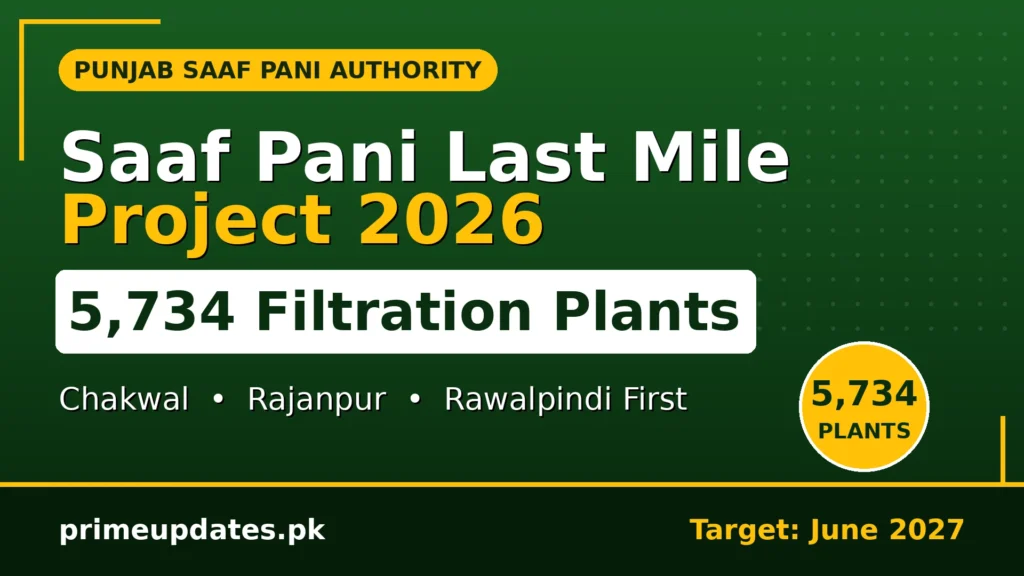
Clean drinking water is a daily need for every household in Punjab, and for many villages it is still a walk to a distant source or a payment to a tanker. The Punjab Saaf Pani Authority has now approved a province-wide plan to close that gap. The Last Mile Water Supply Project aims to take filtration plants to the communities that are still unserved, with a fixed completion target of June 2027.
This guide explains the project in plain terms: which districts get water first, how you actually collect it, who repairs your village plant when it breaks, and how to stay safe from fraud. Readers looking for other Punjab welfare programmes can also browse the Government Schemes hub for related updates.
Is Article Mein
- What the Last Mile Water Supply Project Is
- Which Districts Get Water First
- How to Actually Get Water
- Who Looks After Your Village Plant
- How to Report a Broken Plant
- CM Water Bottling Project: 19-Litre Bottles for Four Districts
- Restoring 736 Dysfunctional Plants
- Scam Warning: No Fee, No Form, No Agent
- FAQs
What the Last Mile Water Supply Project Is
The Punjab Saaf Pani Authority meeting chaired by Chief Minister Maryam Nawaz on 25 October 2026 approved the Last Mile Water Supply Project. The project sets a province-wide target of 5,734 water filtration plants, to be completed by June 2027, according to The News on 26 October 2026. The name says what it means: the last mile is the final stretch to communities that the existing network has not yet reached.
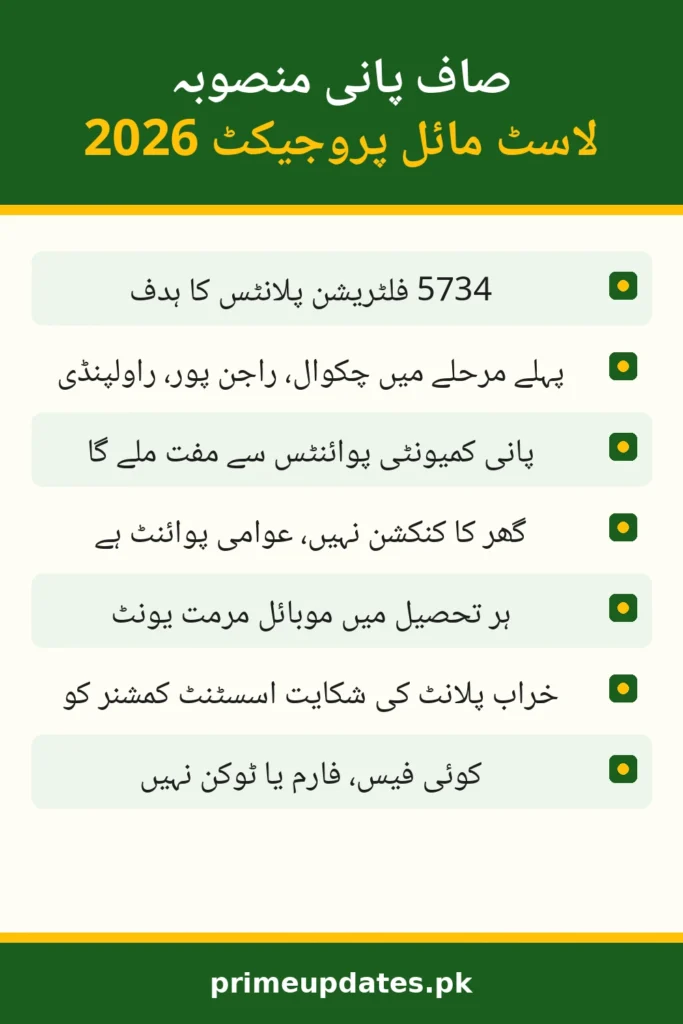
One figure needs to be understood correctly. The 5,734 figure is the total province-wide target, not the number of brand-new plants to be built from scratch. The Authority reports that 5,703 plants are already operating, so the project is about completing coverage across the province rather than starting from zero. Readers should therefore not expect 5,734 new constructions in their own district, but a finished network that reaches the remaining areas.
Which Districts Get Water First
The first phase covers the worst-affected areas, and three districts are named first: Chakwal, Rajanpur, and Rawalpindi. Schemes covering 256 kilometres in Chakwal and 1,780 kilometres in Rajanpur have been prioritised, which shows where the earliest work is concentrated. These are the districts where the need is greatest and where residents should watch for the first new plants.
More areas will follow after these three districts, in line with the June 2027 province-wide target. If your district is not in the first phase, the project has not skipped you; the rollout is staged, and the first-phase districts are simply where work begins. The table below lists the first-phase districts and the priority work named for each.
| District | Priority work named |
|---|---|
| Chakwal | Schemes covering 256 km prioritised |
| Rajanpur | Schemes covering 1,780 km prioritised |
| Rawalpindi | Among the first-phase worst-affected areas |
How to Actually Get Water
The most common misunderstanding about this project is that it brings a water pipe to each house. It does not. Water under this project is collected from public community points, where filtration plants serve the neighbourhood. You go to the plant serving your area and collect water there, rather than receiving a connection at your doorstep.
This distinction matters for planning your day. Because the plant is shared, it is worth knowing which plant serves your street or village and its working hours once it opens. Households should treat the community point as their source, keep clean containers ready, and avoid depending on a private tanker for water that the public plant is meant to supply.
Who Looks After Your Village Plant
A filtration plant only helps as long as it keeps working, and the project has a maintenance setup for that. Every tehsil has mobile maintenance units made up of plumbers and technical staff, whose job is the repair and rehabilitation of plants. When a plant stops working, these units are the hands that fix it.
Oversight sits with the local administration. Assistant commissioners monitor the plants, and public committees working under the assistant commissioners oversee the neighbourhood plants. This means your plant has both a repair team and a local body watching it, rather than being left to run on its own after installation. The table below shows who does what.
| Responsibility | Who handles it |
|---|---|
| Repair and rehabilitation of plants | Mobile maintenance units in every tehsil, with plumbers and technical staff |
| Monitoring of plants | Assistant commissioners |
| Oversight of neighbourhood plants | Public committees working under assistant commissioners |
How to Report a Broken Plant
If your village plant stops working, do not wait for someone else to notice it. A broken plant affects the whole neighbourhood, and the maintenance system only moves when the fault is reported. Start with the people closest to the plant, and move up if nothing happens, because each level in the system has a defined role.
When you report, say clearly which plant is affected and what has stopped working, so the repair team can come prepared. A vague complaint takes longer to act on than a specific one, and the mobile unit can only fix what it knows is broken. The steps below follow the maintenance setup described for the project.
- Tell your neighbourhood public committee that oversees the plant
- Raise the fault with the assistant commissioner’s office, which monitors the plants
- The tehsil mobile maintenance unit then carries out the repair or rehabilitation
CM Water Bottling Project: 19-Litre Bottles for Four Districts
Alongside the filtration plants, the CM Water Bottling Project supplies bottled water in four districts: Khushab, Dera Ghazi Khan, Rahim Yar Khan, and Bahawalpur. Plants in these districts produce 10,000 bottles of 19 litres each day, and more than 75,000 bottles have already been delivered to households. The project reports that 4.8 million people have benefited so far.
This bottling project is separate from the filtration plants, and it serves a different need. Filtration plants give communities a daily collection point, while bottled water reaches households in the four named districts. Residents of Khushab, Dera Ghazi Khan, Rahim Yar Khan, and Bahawalpur should therefore look at both parts of the programme when checking what is available to them.
Restoring 736 Dysfunctional Plants
Separately from the Last Mile target, the Authority is restoring 736 dysfunctional plants by the end of 2026. These are plants that already exist but stopped working, and bringing them back is faster than building replacements. For villages with a dead plant, this restoration work may matter more than any new construction.
The 736 figure must not be added to the 5,734 target, because the two numbers describe different things. The 5,734 figure is the province-wide filtration plant target for June 2027, while the 736 figure is a restoration count for existing plants by the end of 2026. Keeping them apart avoids the common error of presenting one combined number that the project never announced.
Scam Warning: No Fee, No Form, No Agent
Reports about the project say that water at the public points carries no connection fee, and that no form or token is needed to collect it. This free-water wording comes from secondary reports, not from The News report of the approval, so readers should treat it as the reported position rather than a quoted official promise. What is certain is that no one in the project has any reason to charge you for access to a public plant.
If anyone demands money for a connection, asks you to buy a form or token, or claims to be an agent who can get your village included, do not pay. Such a person is not part of the project, and paying only encourages the fraud. Report the extortion attempt to the Deputy Commissioner’s complaint cell or through the Citizen Portal, so the administration can act against it.
- Someone demands a fee for a water connection
- Someone asks you to fill a form or buy a token to collect water
- Someone claims to be an agent who can get your village included
- Someone asks for payment to repair or register a plant
FAQs
Will I get a water connection at my home under this project?
No, this project does not install a pipe to each house. Water is collected from public community points served by filtration plants in your neighbourhood.
When will my district get filtration plants?
Chakwal, Rajanpur, and Rawalpindi are in the first phase as the worst-affected areas. More areas follow after these three, with the province-wide target set for June 2027.
Who repairs my village plant if it breaks?
The tehsil mobile maintenance unit, made up of plumbers and technical staff, carries out repairs. Assistant commissioners monitor the plants, and public committees oversee neighbourhood plants.
Is the water really free?
Reports about the project say there is no connection fee and no form or token is needed. Never pay anyone who claims to be an agent, and report extortion to the Deputy Commissioner’s complaint cell or the Citizen Portal.
What is the difference between the 5,734 plants and the 736 plants?
The 5,734 figure is the total province-wide filtration plant target for June 2027. The 736 figure is a separate restoration count for existing dysfunctional plants, due by the end of 2026.
What about the 19-litre bottles?
The CM Water Bottling Project runs in Khushab, Dera Ghazi Khan, Rahim Yar Khan, and Bahawalpur. Its plants produce 10,000 bottles of 19 litres daily, and more than 75,000 bottles have been delivered to households so far.
Disclaimer: PrimeUpdates.pk is an independent information website and is not affiliated with the Punjab government or the Punjab Saaf Pani Authority. Always verify details on official sources before acting on them.