Punjab Himmat Card: Rs 10,500 Quarterly Stipend for Persons with Disabilities
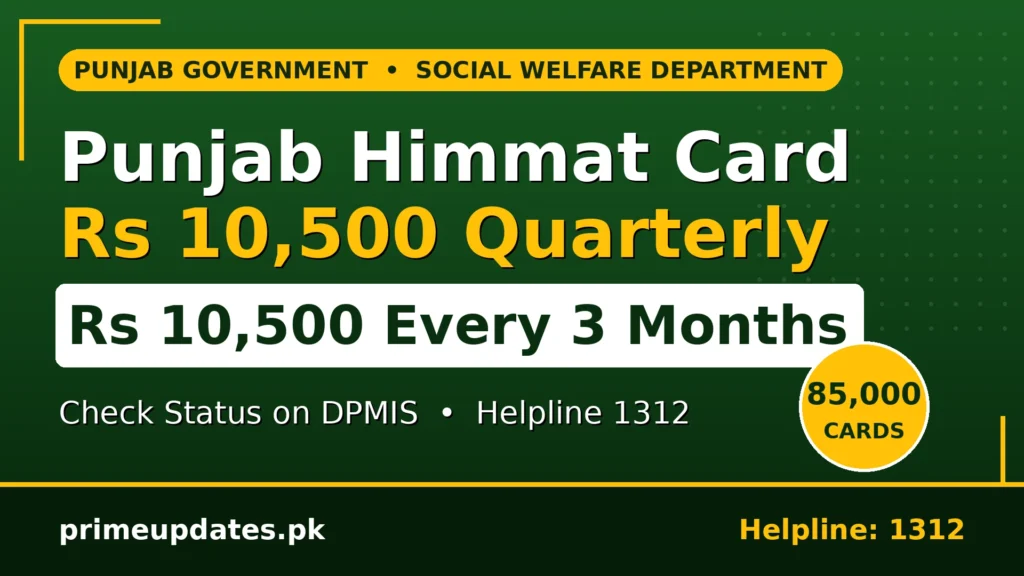
Persons with disabilities in Punjab who cannot work can receive regular financial support through the Himmat Card. The card pays Rs 10,500 every three months through an ATM card, and it is issued by the Government of Punjab through the Social Welfare Department. The aim is to support the daily needs of people assessed as not fit to work.
This guide explains the programme in plain terms: who qualifies, what documents you need, how to check your status on the official DPMIS portal, how the batches work, and how to stay safe from fraud. There is no published deadline for this programme, because cards are issued batch by batch. Readers looking for other Punjab welfare programmes can also browse the Government Schemes hub for related updates.
Is Article Mein
- What the Himmat Card Is
- Who Is Eligible for the Himmat Card
- Documents You Need
- How to Check Your Himmat Card Status
- How Registration and Shortlisting Work
- Himmat Card Batches: How Far Distribution Has Reached
- How and When You Receive the Rs 10,500 Payment
- What to Do If Your Card or Payment Has Not Arrived
- Scam Warning: No Agent, No Form for Sale
- FAQs
What the Himmat Card Is
The Himmat Card is a government initiative that provides a quarterly stipend of Rs 10,500 to eligible persons with disabilities. The card is issued by the Government of Punjab through the Social Welfare Department, and its objective is to give financial assistance to persons with disabilities assessed as not fit to work, so that they can meet their daily needs with greater independence.
The card is only for Punjab. It is available to eligible persons with disabilities residing in Punjab whose CNIC is registered in Punjab, and it is not available in other provinces. The stipend of Rs 10,500 every three months works out to about Rs 3,500 a month, paid once a quarter rather than every month.
Who Is Eligible for the Himmat Card
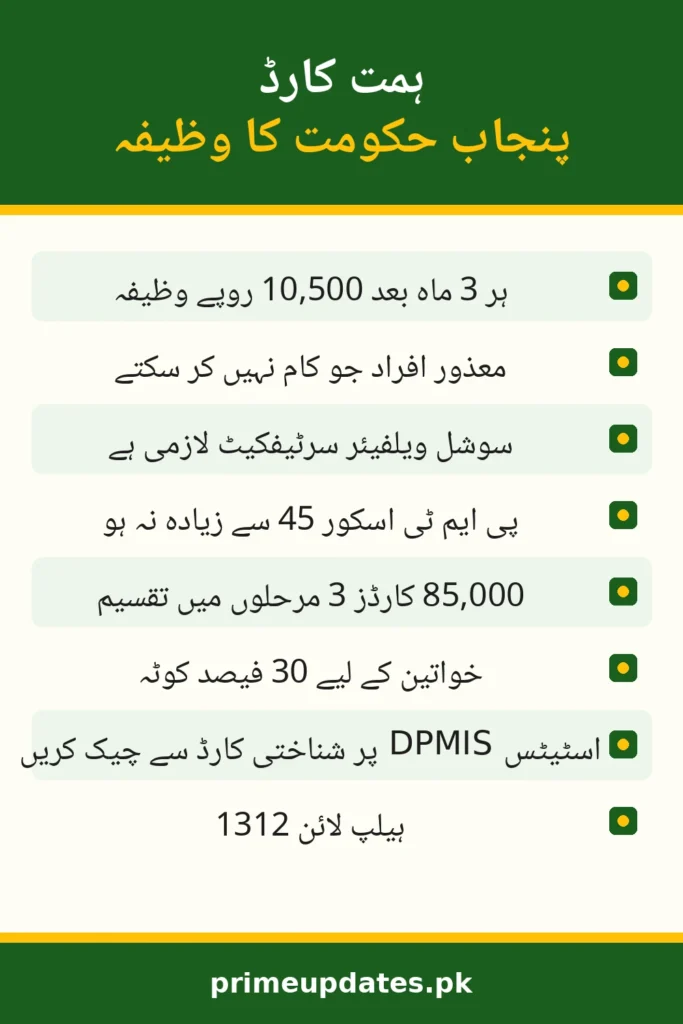
A person is eligible only when all of the following conditions are met together: certified as a person with disability by Social Welfare Punjab, assessed as not fit to work, not employed in any government or private office, not receiving financial assistance from BISP, PSPA, Zakat or similar programmes, and a PMT score that does not exceed 45. The person’s CNIC must also be registered in Punjab.
A child with a disability can also be eligible. If the child is certified as a person with disability and meets the eligibility criteria, the parent or guardian is considered on the child’s behalf. There is no specific age limit for the programme, but every applicant must meet the same eligibility criteria. Readers who receive BISP support can check the BISP qist update to understand that programme separately, because receiving BISP aid makes a person ineligible for the Himmat Card.
| Condition | Rule |
|---|---|
| Disability certification | Certified as a person with disability by Social Welfare Punjab |
| Fitness for work | Assessed as not fit to work |
| Employment | Not employed in any government or private office |
| Other aid | Not receiving BISP, PSPA, Zakat or similar financial assistance |
| PMT score | Must not exceed 45 |
| Residence | CNIC registered in Punjab |
Documents You Need
Three things are required for eligibility. The applicant must provide a valid CNIC or B-Form issued by NADRA, a disability certificate from the Social Welfare Department, and updated contact details and residential address. These three items form the record on which eligibility is decided.
Keeping that record updated matters as much as having the documents. If a CNIC is shortlisted but the data is not updated, the record must be updated through the DPMIS portal or at the Social Welfare Office. An expired CNIC is not accepted for the Himmat Card, so it must be renewed through NADRA before payments can proceed.
How to Check Your Himmat Card Status
You can check your status online through the official verification page at dpmis.punjab.gov.pk/himmatcard-verification, or by contacting the Social Welfare Office. The check uses the 13-digit CNIC of the person with disability, not the guardian’s CNIC, and for a child the check still runs on the child’s record.
Once you submit the CNIC, the page shows your status. If your CNIC is shortlisted but your data is not updated, update your details through the DPMIS portal or visit the Social Welfare Office, because payments and card delivery depend on a correct record. The steps below follow the official verification process.
- Open the official verification page at dpmis.punjab.gov.pk/himmatcard-verification
- Enter the 13-digit CNIC of the person with disability, without dashes
- Submit and read the result on screen
- If your data is incomplete, update it through the DPMIS portal or your Social Welfare Office
How Registration and Shortlisting Work
The route to the card runs through DPMIS registration and the disability board. The disabled person is registered on DPMIS with their CNIC or B-Form, attends the district disability board when called, and the board decides the disability type and whether the person is fit to work. After that, the Social Welfare disability certificate is issued and the DPMIS record is kept updated.
There is no separate Himmat Card form to buy or submit. Eligible people are shortlisted automatically from their DPMIS data, and details can still be updated through the DPMIS portal or the Social Welfare Office even after a person has been automatically shortlisted. Because selection is automated, no one can arrange a place on the list from outside the system.
Himmat Card Batches: How Far Distribution Has Reached
The programme intends to distribute ATM cards to 85,000 eligible individuals. Batch I covered 40,000 eligible individuals and is completed, Batch II covered 25,000 eligible individuals and is completed, and Batch III covers 20,000 eligible individuals and is underway, according to the official programme page.
That batch position explains why an eligible person may still be waiting. The first 65,000 beneficiaries with clean and clear data were shortlisted on a first-come, first-served basis, and others are considered in future batches. A 30 percent quota has also been reserved for women under the programme.
| Batch | People | Status |
|---|---|---|
| Batch I | 40,000 | Completed |
| Batch II | 25,000 | Completed |
| Batch III | 20,000 | Underway |
| Total target | 85,000 | — |
How and When You Receive the Rs 10,500 Payment
Each eligible beneficiary receives Rs 10,500 per quarter through the Bank of Punjab ATM card. The payment follows a quarterly cycle of three months, so the amount arrives once every three months rather than monthly, and an SMS is sent with the payment details.
If you have received your card but your payment has not been transferred, wait for the designated quarterly period first, because the stipend is quarterly by design. If the payment still does not arrive after that period, check your bank account details, visit your nearest district camp office, or contact the helpline 1312 for assistance.
What to Do If Your Card or Payment Has Not Arrived
If your card has not arrived, check your status on the portal first and make sure your DPMIS data is complete and updated. There is no need to file a complaint about a missing card, because it is issued through an automated system based on the eligibility criteria, and people not among the first 65,000 are considered in future batches. If you lose a card you already received, report it to the Social Welfare Department and request a replacement.
Two practical problems have their own fixes. If your fingerprint does not match during biometric verification, update your fingerprint data through camp officers or service providers and try again. If your CNIC has expired, renew it through NADRA, since an expired CNIC is not accepted. For any other problem, call the helpline 1312 or visit your social welfare and bait-ul-maal district or tehsil camp office.
Scam Warning: No Agent, No Form for Sale
Because selection is automatic from DPMIS data, no person can arrange, speed up, or guarantee your Himmat Card. There is no separate form to buy, no payment that puts you on the list, and no shortcut around the disability board assessment. Anyone offering one of these is not part of the programme.
Use only the official channels: the DPMIS portal, the Social Welfare Office or camp office, and the helpline 1312. If someone contacts you outside these channels and asks for money or personal documents in return for a card, do not deal with them, and report the matter to the Social Welfare Department.
- Someone demands money to arrange or speed up your Himmat Card
- Someone sells you a Himmat Card form or registration
- Someone promises a guaranteed card or a place in a batch
- Someone claims they can skip the disability board assessment for you
FAQs
Who qualifies for the Himmat Card?
A person with disability certified by Social Welfare Punjab and assessed as not fit to work, not employed, not receiving BISP, PSPA or Zakat aid, with a PMT score of 45 or below and a Punjab-registered CNIC.
How much money does the card pay, and how often?
Rs 10,500 every three months through a Bank of Punjab ATM card. That works out to about Rs 3,500 a month, paid once a quarter.
How do I check my Himmat Card status?
Open the official verification page at dpmis.punjab.gov.pk/himmatcard-verification and enter the 13-digit CNIC of the person with disability. You can also ask at your Social Welfare Office or call 1312.
I am eligible but I have no card. What should I do?
Check your status first and make sure your DPMIS data is updated. Cards went first to 65,000 people with clean data, so others wait for future batches, and no complaint is needed.
Is there a deadline to apply?
No deadline has been published. Cards are issued batch by batch, so the right step is to keep your DPMIS record complete and updated.
Can a disabled child get the Himmat Card?
Yes, if the child is certified and meets the conditions. The parent or guardian is considered on the child’s behalf, and there is no specific age limit.
Disclaimer: PrimeUpdates.pk is an independent information website and is not affiliated with the Punjab government or the Social Welfare Department. Always verify details on official sources before acting on them.