Electricity Protected Limit May Rise to 250 Units: What It Means for Your Bill
Is Article Mein
- Latest Update: What the Power Minister Announced in the Senate
- What Is a Protected Consumer?
- How the Current 200-Unit Rule Works
- What Will Change if the 250-Unit Limit Is Approved
- When Will This Change Apply to Your Bill?
- Targeted Subsidy Through BISP From January 2027
- What You Should Do Now
- FAQs
- Conclusion
Latest Update: What the Power Minister Announced in the Senate
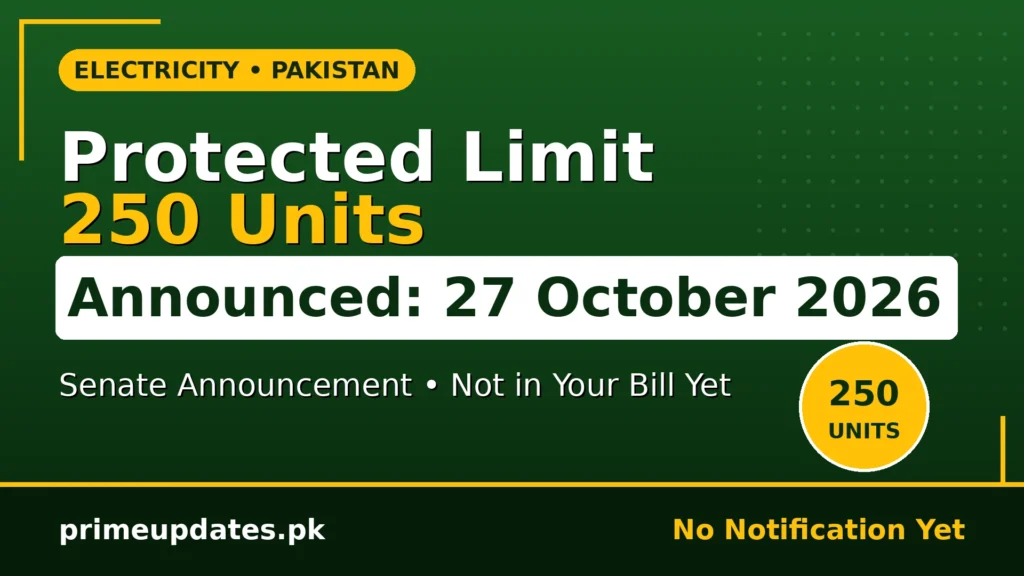
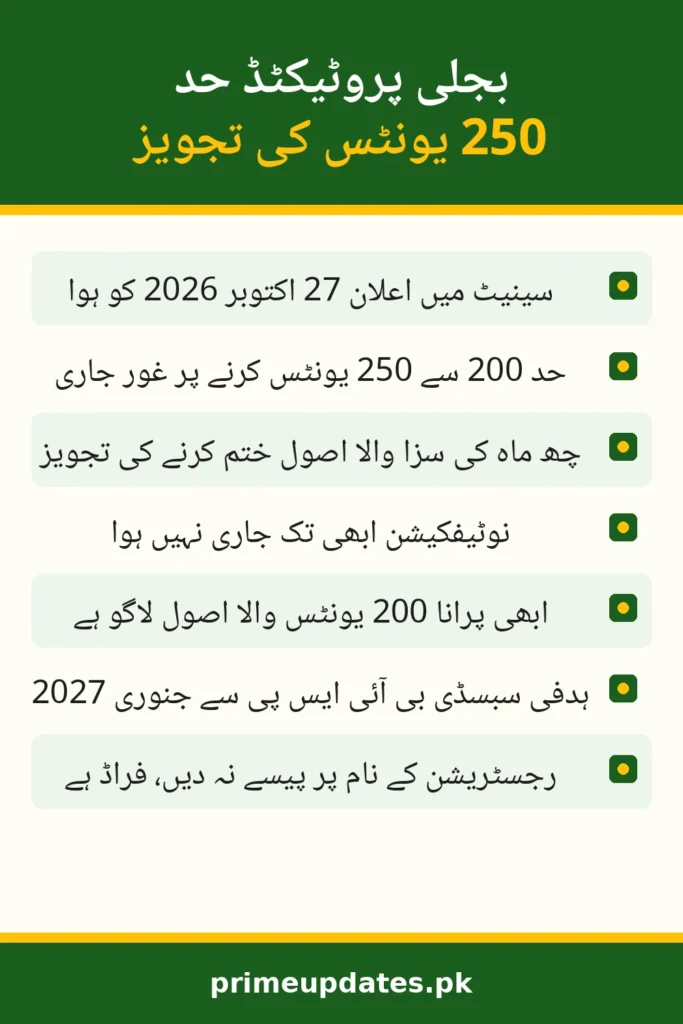
On 27 October 2026, Power Minister Awais Ahmad Khan Leghari told the Senate that the government is working to change the electricity slab system that punishes families for crossing 200 units. He was replying to a calling-attention notice by Senator Abid Sher Ali about slab-based billing by the distribution companies. The minister said the system is being reviewed so that one difficult month does not push a poor family into expensive billing for a long time.
The minister placed two options before the House. The first option is to raise the protected limit from 200 units to 250 units per month. The second option is to end the six-month penalty, so a consumer who comes back within the limit gets the protected benefit again in that same month. He said work on these changes is being expedited, and the plan may take about one to one and a half months to finalise.
What Is a Protected Consumer?
A protected consumer is a household that uses 200 units or less every month and therefore pays much lower per-unit rates. This category was made for low-income families who use a few fans, lights and a small number of basic appliances. Because their usage stays low, the government supports them through lower tariff slabs.
The number of protected consumers has grown very fast in the last two years. The minister told the Senate that their number has risen from about 10 million to between 20 and 25 million, and NEPRA’s own record shows 20.71 million subsidised consumers by June 2025. One big reason is rooftop solar: many families who installed solar panels, like the households covered in our CM Punjab Free Solar Panel Scheme guide, now take less than 200 units from the grid, so they also fall into the protected category even if they are not poor.
How the Current 200-Unit Rule Works
Under the rule in force today, a household must stay at or below 200 units in each of the last six months to keep protected status. If the meter crosses 200 units in even one month, the family loses the protected rate and stays on the higher non-protected tariff until it completes six straight months within the limit again. This is why one month of heavy use, such as guests in summer or a wedding at home, becomes expensive for a long time.
The loss is not small, because the rate jumps sharply at 201 units. In the Senate debate, figures of about Rs 15 rising to about Rs 30 per unit were quoted, but the notified base rates tell the exact story: a protected consumer pays Rs 13.01 per unit in the 101–200 slab, while 201–300 units are charged at Rs 33.10 per unit on the non-protected side. These are base rates, before fixed charges, fuel price adjustment and taxes are added to the bill.
| Category | Monthly Units | Base Rate per Unit |
|---|---|---|
| Protected | 1–100 | Rs 10.54 |
| Protected | 101–200 | Rs 13.01 |
| Non-protected | 1–100 | Rs 22.44 |
| Non-protected | 101–200 | Rs 28.91 |
| Non-protected | 201–300 | Rs 33.10 |
| Lifeline | Up to 50 | Rs 3.95 |
| Lifeline | 51–100 | Rs 7.74 |
What Will Change if the 250-Unit Limit Is Approved
If the first option is approved, families using up to 250 units a month will stay inside the protected category instead of falling out at 201 units. This will directly help households whose normal use is slightly above 200 units, such as families running one extra fan, a water motor or a small fridge through the summer. It will also reduce the fear that one heavy month ruins the bill of the whole season.
If the second option is approved, the six-month wait will end. A consumer who crosses the limit in one month will get the protected benefit back in the very next month in which usage is within the limit. Two points are still not announced: whether a six-month record test will apply at the 250-unit level, and what exact rates will be charged for the 201–250 unit band. No family should treat these details as final until the official notification is issued.
- Protected limit may rise from 200 units to 250 units per month
- Six-month penalty after one heavy month may be abolished
- Protected benefit may return in the same month a family comes back within the limit
- Rates for the new 201–250 unit band are not announced yet
| Point | Current Rule (In Force) | Announced Plan (Not Notified) |
|---|---|---|
| Protected limit | 200 units per month | 250 units per month |
| One month above the limit | Protected rate lost for six months | Benefit returns in the month usage is back within the limit |
| Subsidy system | Lower slabs for everyone up to 200 units | Targeted subsidy through BISP from January 2027 |
| Status today | Applies to your bill now | Announced in the Senate on 27 October 2026, notification awaited |
When Will This Change Apply to Your Bill?
As of today, this change has NOT started. There is no NEPRA determination, no Power Division notification and no effective date for the 250-unit limit, so your next bill will still be calculated under the 200-unit rule. The minister’s own timeline was about one to one and a half months to finalise the plan, which points to around mid-December 2026, but a timeline given in the House is not a promise of a date.
Even after the plan is finalised, it will need government approval, a NEPRA decision and a federal notification before any distribution company can bill on it. Until that notification appears, any message on social media claiming that bills have already become cheaper is not correct. We will update this article as soon as the official notification is issued.
Targeted Subsidy Through BISP From January 2027
A second, bigger change is also coming. Under Pakistan’s commitments with the IMF, the general cross-subsidy on consumption up to 200 units is to be replaced with a targeted subsidy for low-income families through the Benazir Income Support Programme, to be implemented from January 2027. The power-sector subsidy budget for that year is Rs 830 billion, and the targeting is expected to use BISP’s National Socio-Economic Registry data.
This means the coming system has two parts: relief on the unit limit for ordinary consumers, and direct protection for genuinely poor families through BISP records. Families registered with BISP should keep their records and mobile numbers updated, because future electricity support is likely to be checked against that data. Families who face billing problems today can use the verified numbers in our Official Punjab Helpline Numbers guide to reach the right office.
What You Should Do Now
Until the notification is issued, the safest course is to keep your monthly usage at or below 200 units, because the old rule is still fully in force. Check the consumer category printed on your bill: it shows whether you are being billed as protected or non-protected, and your last months’ unit history shows how close you are to losing the protected rate. Small savings, like turning off extra fans and lights, still protect your next six bills.
Also be careful about fraud. No official has announced any registration, form or fee for the 250-unit facility, because the facility does not exist yet. If any person or page asks for money to “register” your meter for the new limit, it is a scam. Only trust announcements from NEPRA, the Power Division or your own distribution company.
- Keep monthly usage at or below 200 units until the notification is issued
- Check the protected or non-protected category printed on your bill
- Do not pay any person or page for “registration” of the new limit
- Follow only NEPRA, Power Division and your DISCO for the final date
FAQs
Has the 250-unit protected limit started?
No. It was announced in the Senate on 27 October 2026, but no official notification has been issued yet.
Your bill is still calculated under the current 200-unit rule.
When will the 250-unit limit apply to bills?
The Power Minister said the plan may take one to one and a half months to finalise.
The change will apply only after government approval, a NEPRA decision and a federal notification.
I used more than 200 units last month. Will I get relief now?
Not yet. Under the current rule, you regain the protected rate only after six straight months within the limit.
If the second option is approved, the benefit will return in the month your usage is back within the limit.
What are the current protected rates?
Protected consumers pay a base rate of Rs 10.54 per unit for the first 100 units and Rs 13.01 per unit up to 200 units.
These are base rates, and fixed charges, fuel adjustment and taxes are added on top.
What is the BISP targeted subsidy for electricity?
From January 2027, the general subsidy on low slabs is planned to be replaced with support for low-income families through BISP.
The targeting is expected to use BISP’s National Socio-Economic Registry data.
How can I check whether I am a protected consumer?
Your bill shows your consumer category and tariff, along with the units used in recent months.
If the category does not say protected, your DISCO office or helpline can confirm the reason.
Conclusion
The Senate announcement of 27 October 2026 is good news for more than 20 million households, because a 250-unit protected limit and the end of the six-month penalty would remove the harshest part of slab billing. But it is still an announcement, not a notification, and the 200-unit rule decides your bill today. Keep your usage within the current limit, ignore anyone selling early registration, and wait for the official notification, which this page will report as soon as it is issued.
Disclaimer: Prime Updates is an independent information website and is not affiliated with NEPRA, the Power Division, any distribution company or BISP. Rates and rules are taken from official decisions and Senate reporting; please confirm your final bill details with your distribution company.