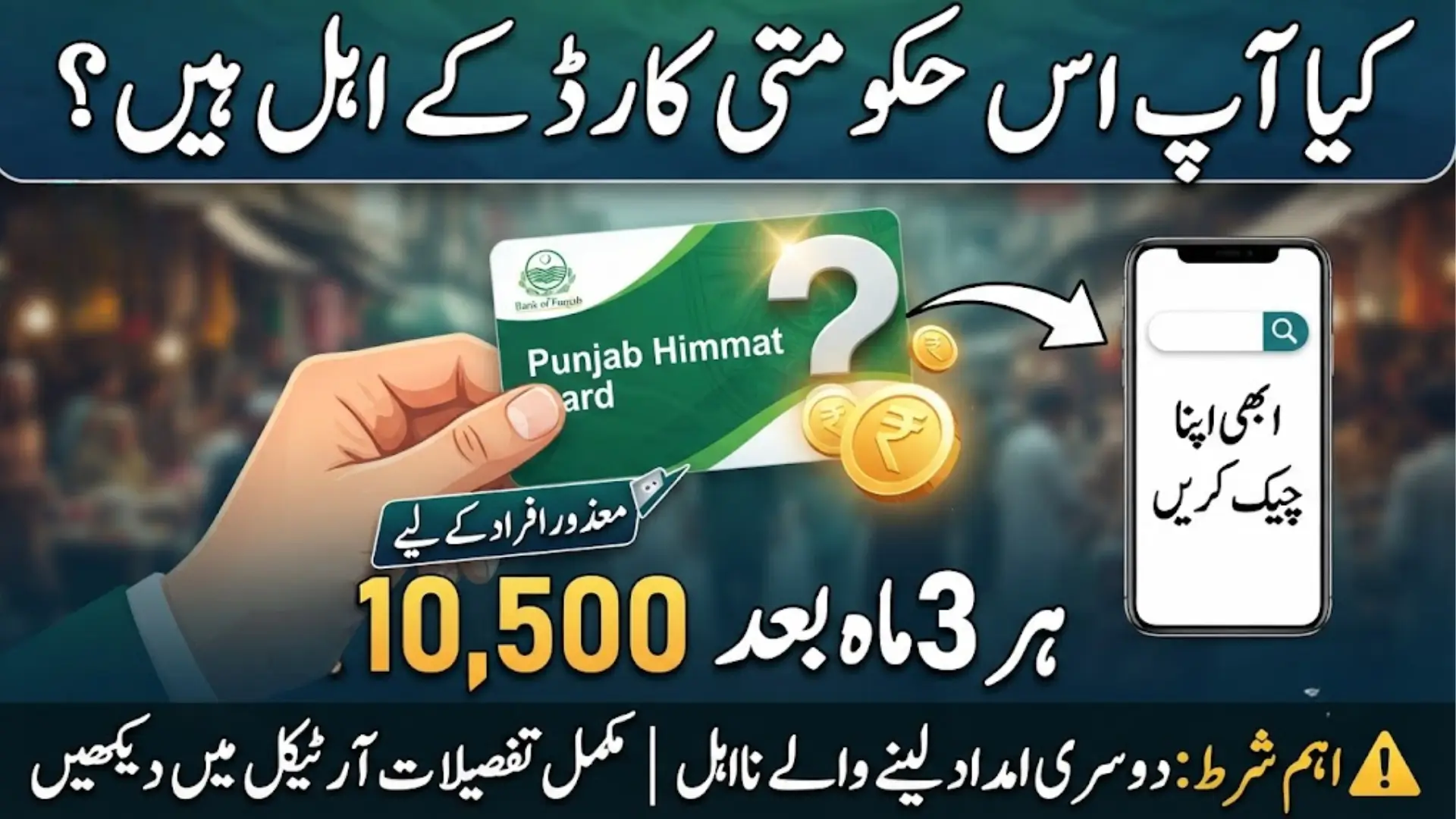
Punjab Himmat Card Program
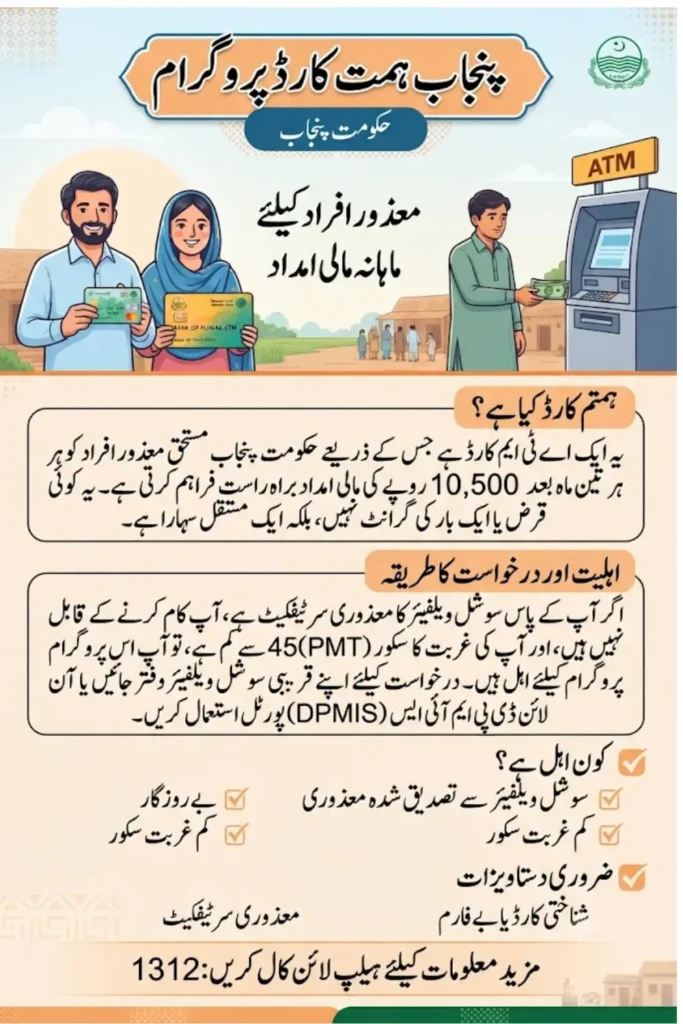
The Himmat Card Program is the Punjab government’s flagship financial support scheme for persons with disabilities. If you or someone in your family has a disability certificate from the Social Welfare Department, this card could mean a steady Rs. 10,500 landing in your account every three months.
Here’s the short version: it’s not a loan, it’s not a one-time grant, and it’s not means-tested in the usual bureaucratic sense it runs on a specific poverty score and a “not fit to work” assessment. That said, the rules are stricter than a lot of online guides make them sound, so let’s go through what’s actually verified by the Social Welfare Department rather than what’s floating around on random blogs.
What Is the Himmat Card, Exactly?
The Himmat Card is best described as a package, not a single benefit. Right now, the one live component is a quarterly cash stipend of Rs. 10,500, paid onto an ATM-enabled card issued through the Bank of Punjab. The Social Welfare & Bait-ul-Maal Department has said other services may be added to the same card down the line, but as of today the stipend is the program.
An MOU between the Social Welfare & Bait-ul-Maal Department and the Bank of Punjab set the mechanics in motion, with Bank of Punjab acting as the payment service provider. Camp sites were set up at the tehsil level so beneficiaries could open accounts with help from bank staff, rather than having to figure out account-opening paperwork on their own. Withdrawals from Bank of Punjab ATMs and branchless banking partners don’t carry a service charge, which matters when you’re talking about a fixed stipend.
Punjab Dhee Rani Program 2026: Who Can Apply? Full Eligibility, Benefits & Registration Process
Where the Money Comes From
The program launched with a budget allocation of roughly Rs. 2.658 billion. That’s a meaningful number because it tells you the government sized the scheme for a fixed group of beneficiaries it wasn’t designed as an open-ended entitlement that expands automatically as more people apply. New batches get added when the government decides to fund them, not the moment someone qualifies.
Eligibility Criteria What the Social Welfare Department Actually Requires
This is where a lot of guides get sloppy. The official Social Welfare Department page lists specific, checkable conditions, and honestly, missing even one of these is the most common reason applications stall.
To qualify, you need to meet all of the following:
- Be certified as a Person with Disability by Social Welfare Punjab
- Be assessed as “Not Fit to Work” a working-age applicant who’s medically fit for employment won’t clear this bar
- Not be employed in a government or private office
- Not have recently received a grant from Bait-ul-Maal, the Zakat Fund, PSPA, or BISP
- Have a Proxy Means Test (PMT) score of 45 or below, as issued by BISP
- Have complete, updated data in the DPMIS system CNIC, address, mobile number, education, and experience
That PMT score cutoff trips up a surprising number of applicants. If your household’s poverty score sits above 45, the system flags you as not eligible regardless of your disability certificate worth checking before you invest time in the rest of the process.
Documents You’ll Need
Beyond the criteria above, applicants typically need a valid CNIC or B-Form, the disability certificate from the Social Welfare Department, and updated contact and residential details. Parents or guardians can apply on behalf of a certified disabled child using the child’s B-Form together with the disability certificate there’s no minimum age requirement written into the eligibility rules.
How the Rollout Has Worked So Far
The program wasn’t launched as a single mass distribution. It’s gone out in batches, and understanding the batch structure explains why some eligible people are still waiting.
| Batch | Beneficiaries | Status |
|---|---|---|
| Batch I | 40,000 | Completed |
| Batch II | 25,000 | Completed |
| Batch III | 20,000 | In progress |
| Total planned | 85,000 | — |
The Chief Minister directed that payments begin by mid-September, and disbursement did start on schedule once the Bank of Punjab account-opening camps were running. A 30% quota is reserved specifically for women with disabilities across all three batches this isn’t a separate scheme, it’s a fixed carve-out within the same 85,000 total.
If you’ve applied and haven’t received a card yet, it doesn’t automatically mean rejection. It can just mean you’re queued for a batch that hasn’t been funded and rolled out yet.
How to Apply and Check Your Status
Registration happens through the DPMIS (Disabled Persons Management Information System), either online or by visiting a District Social Welfare Office in person if you don’t have reliable internet access.
Online route: create a DPMIS profile using your CNIC, fill in your disability and contact details, and upload your documents. Offline route: visit your nearest Social Welfare office with your CNIC, disability certificate, and photographs, and a field officer will help with the paperwork.
Once you’ve applied, you can check your status through the official verification portal at dpmis.punjab.gov.pk/himmatcard-verification by entering your CNIC number. If the portal shows you as verified but you still haven’t received a card, that’s usually a batch-timing issue rather than an error there’s no need to file a formal complaint in that case, since issuance is handled by an automated, criteria-based system rather than manual case review.
Getting Help
The government runs a dedicated helpline 1312 for anything related to registration, card delays, or payment questions. If your CNIC has expired, note that an expired CNIC won’t be accepted anywhere in the process, so renewing it at NADRA first will save you a wasted trip.
Himmat Card vs. Other Punjab Welfare Support
People often mix this scheme up with other social protection programs, so here’s how it actually differs.
| Feature | Himmat Card | BISP (Kafalat) | Zakat/Bait-ul-Maal |
|---|---|---|---|
| Target group | Certified PWDs, not fit to work | Low-income women/households | General poverty relief |
| Payment amount | Rs. 10,500 / quarter | Varies by program | Varies by case |
| Can you receive both? | No receiving BISP/Zakat/PSPA disqualifies you | N/A | N/A |
| Administered by | Punjab Social Welfare Department | Federal BISP | Provincial Zakat/Bait-ul-Maal |
| Card type | Bank of Punjab ATM card | Varies | Usually cash disbursement |
That “can you receive both” row matters a lot. If you’re already drawing support from BISP, PSPA, or a Zakat/Bait-ul-Maal grant, you’re not eligible to stack the Himmat Card on top the eligibility rules explicitly exclude double-dipping.
Benefits Beyond the Cash Stipend
The headline benefit is the money, obviously, but a few practical details are worth knowing before you assume this works like a normal bank account:
- Rs. 10,500 paid every three months directly to your Himmat Card
- Free withdrawals at Bank of Punjab ATMs and branchless banking agents no service charge eats into your stipend
- Account opening handled through dedicated tehsil-level camps, so you’re not left navigating standard bank onboarding alone
- A guaranteed 30% share of all slots reserved for women with disabilities
- A dedicated helpline (1312) for complaints and status queries, separate from general Social Welfare Department contact lines
Anything beyond these free public transport, laptops, job quotas, or digital skills stipends shows up on some unofficial websites but isn’t confirmed on the Social Welfare Department’s own page as of this writing. If you see those claims elsewhere, treat them as unverified until the department confirms them directly.
Himmat Card Program
Punjab Government Financial Assistance Program for Persons with Disabilities
- Must be a resident of Punjab.
- Must be a registered Person with Disability (PWD).
- Must meet government verification requirements.
- Applicants should possess a valid CNIC and disability registration record.
- Women are encouraged to apply under the reserved 30% quota.
- Quarterly financial assistance of Rs. 10,500.
- Direct ATM Card-based payment system.
- Transparent and secure fund transfer mechanism.
- 85,000 beneficiaries across Punjab.
- Special 30% quota reserved for women beneficiaries.
- Easy verification and support through official channels.
Helpline: 1312
CM Punjab Kissan Card 2026: Eligibility, Loan Limit & How to Apply
FAQs
How much money does the Himmat Card give every quarter? Eligible beneficiaries receive Rs. 10,500 every three months, deposited directly onto their Bank of Punjab-issued Himmat Card.
Who is eligible for the Himmat Card in Punjab? You need a Social Welfare-certified disability, a “not fit to work” assessment, no current job, a BISP PMT score of 45 or under, and no overlapping grant from BISP, Zakat, Bait-ul-Maal, or PSPA.
How can I check my Himmat Card application status? Enter your CNIC on the official verification portal at dpmis.punjab.gov.pk/himmatcard-verification, or call the 1312 helpline for a status update.
Can a disabled child apply for the Himmat Card? Yes. A parent or guardian can apply on behalf of a certified disabled child using the child’s B-Form along with the disability certificate; there’s no stated minimum age.
Is the Himmat Card the same as BISP or Zakat assistance? No. It’s a separate, Punjab-specific program for certified persons with disabilities, and receiving BISP, PSPA, or Zakat funds actually disqualifies you from the Himmat Card rather than supplementing it.
Final Word
The Himmat Card program is genuinely one of the more structured disability support schemes Punjab has rolled out the batch system, the PMT cutoff, and the exclusion of double-benefit recipients all point to a scheme built to target a specific 85,000-person group rather than an unlimited rolling program. If you’re checking eligibility for a family member, start with the PMT score and the disability certification before anything else those two conditions filter out more applicants than any paperwork issue does.